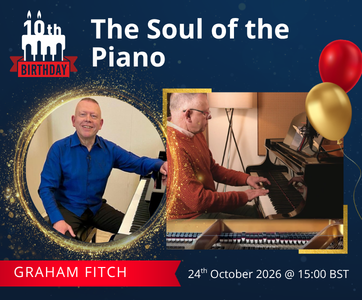
The Soul of the Piano
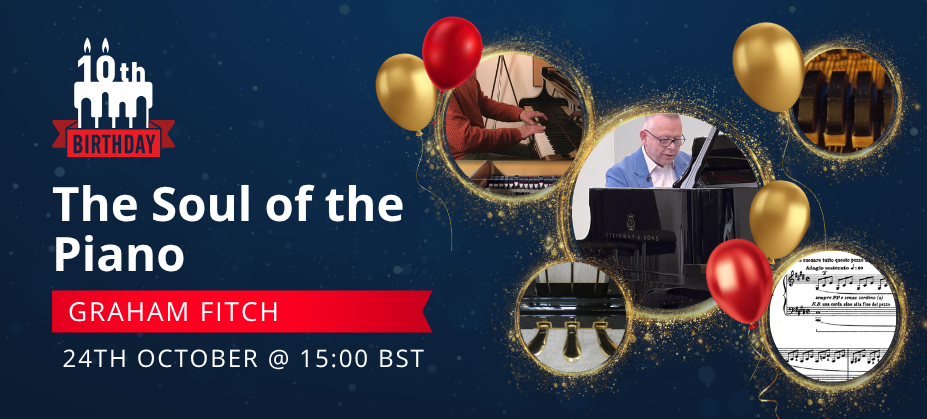
Anton Rubinstein famously referred to the sustaining pedal as the “soul of the piano”. Music from almost any style period will sound impossibly dry and boring without the pedal, like cornflakes without the milk.
Pedalling is often thought of as a black-and-white matter: it is either up or it is down. Yet becoming conscious of the various techniques top pianists use is foundational for creating a really beautiful sound, full of colour and variety. Small dabs of pedal can act as highlights, while long pedals, perhaps with subtle adjustments along the way, can create sumptuous clouds of harmony.
In this interactive workshop, Graham Fitch will begin by looking at what actually happens inside the piano when the sustaining pedal is depressed, including the damper mechanism and sympathetic resonance, before exploring the physical technique of pedalling itself.
From there, Graham will demonstrate direct and legato pedalling, followed by long pedals, dab pedalling and different degrees of half, flutter and partial pedalling. At various points, you will have the opportunity to try the techniques for yourself and listen to the results.
Graham will also address problems he encounters regularly, including smudginess caused by incomplete pedal changes or using too much pedal, treating the pedal as an on-off switch and being overly cautious about longer pedals because of the dissonances they may contain.
Pedal notation is notoriously imprecise. It can never tell us exactly how deeply to depress the pedal or show the subtle adjustments the foot may need to make in order to control the resonance.
Developing the art of pedalling therefore means becoming increasingly sensitive to what the foot is doing, what we are hearing and how changes in timing, depth and movement affect the sound. The result is a far richer palette of colour, clarity, resonance and expression.
What You'll Explore
How the Sustaining Pedal Works
Understand what happens inside the piano when the pedal is depressed, including the damper mechanism, sympathetic resonance and the relationship between fingers, foot and dampers.
Direct and Legato Pedalling
Explore the different coordination required for direct and legato pedalling, including foot position, clean changes and the timing needed to create continuity without blur.
Long and Dab Pedalling
Discover why longer pedals can sometimes create richer harmony than we expect, and how small dabs of pedal can be used selectively to add resonance and colour.
Half, Flutter and Partial Pedalling
Move beyond thinking of the pedal as simply “up” or “down” and explore different depths and movements to retain, adjust and clear resonance more precisely.
Who It's For
This workshop will be useful for pianists at various levels, from approximately late-elementary through to advanced, as well as teachers.
It will be particularly relevant if you:
- are developing greater confidence and coordination with the sustaining pedal;
- find that your pedalling sometimes sounds muddy or blurred;
- follow pedal markings without always knowing exactly what to listen for;
- use the pedal largely by instinct and would like to make more conscious choices;
- are cautious about longer or deeper pedals because you are worried about creating blur;
- would like a wider range of colour, resonance and texture in your playing;
- are already experienced but want to revisit and refine an aspect of playing that is often taken for granted.
Teachers will also gain useful ways of explaining, demonstrating and practising pedalling with students.
What You'll Take Away
By the end of the workshop, you should be better able to:
- create a richer and more varied sound through greater control of colour and resonance;
- avoid unnecessary muddiness by understanding how clean pedal changes work;
- coordinate hands and foot more reliably in direct and legato pedalling;
- move beyond using the pedal as an on-off switch, using different depths and movements with greater awareness;
- listen and respond more actively, rather than relying solely on printed pedal markings;
- use everything from small dabs to longer pedals more confidently, choosing the amount and type of resonance the music needs.
Above all, you should leave with a much clearer sense of what your foot is doing, why you are doing it and what you are listening for.
How It Works
This interactive workshop follows a similar format to the Online Academy’s popular Practice Tools sessions.
Graham will introduce and demonstrate each technique, followed by opportunities to experiment with the ideas yourself through short breakout activities.
You can either use the exercises and musical examples provided on the accompanying worksheet or, where appropriate, try the concepts with passages from your own repertoire.
Participation during the live session is entirely optional. If you prefer to watch and listen, or are unable to join live, the worksheet and event recording will allow you to work through the exercises afterwards in your own time and explore the techniques in greater depth.
The session will be recorded and all ticket holders will receive access to the recording shortly afterwards.
Choose Your Ticket
To book this event on its own for £40, or £24 for Online Academy subscribers, click the Buy button below. Subscribers should sign in first to receive the discounted price.
Want to Attend All Four Birthday Events?
Online Academy subscribers can book all four events for £90 with the Member Event Pass.
Not currently a subscriber? The Birthday Experience includes all four events, unlimited replays and three months of non-renewing Online Academy membership for £135.